Tree Care Tips
How Much Does Stump Grinding Cost in Austin, TX?
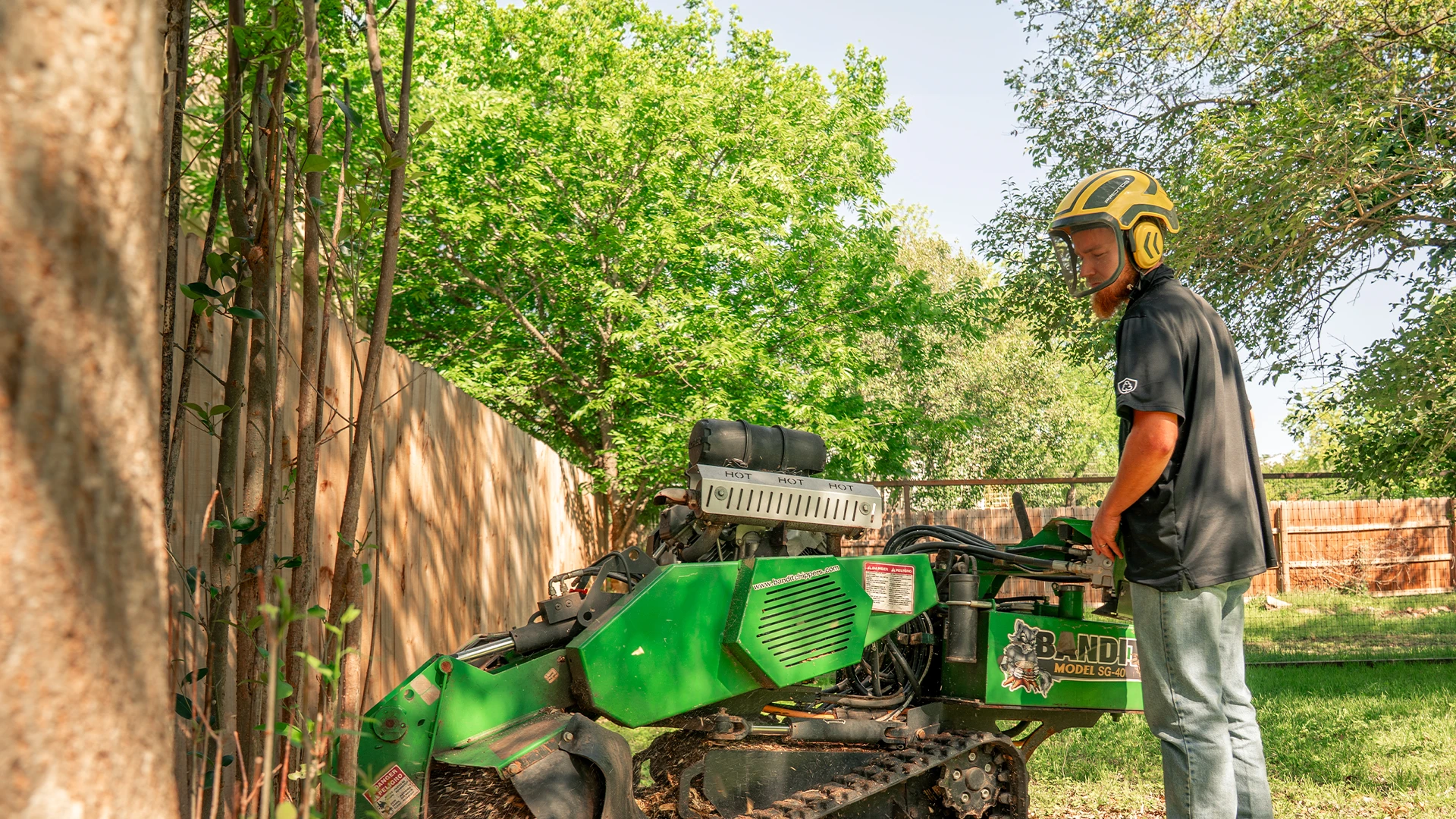
Stump Grinding in Austin: What It Costs and What to Expect
You had a tree removed. The crew drove off. And now you're staring at a stump that's going to sit in your yard until you deal with it. Here's the honest breakdown of what stump grinding actually costs in Austin and what factors drive the price up or down.
Average Stump Grinding Costs in Austin, TX
For most residential stumps in the Austin area, you're looking at $150 to $500 per stump. Here's how that breaks down by size:
- Small stumps (under 12 inches diameter): $100 to $200. Crape myrtles, small ornamentals, young trees. A grinder handles these in 15-20 minutes.
- Medium stumps (12 to 24 inches): $200 to $350. Cedar elms, mid-size oaks, pecans. These take 30-60 minutes depending on the root structure and wood hardness.
- Large stumps (24 inches and up): $350 to $500+. Mature live oaks, heritage pecans, large post oaks. These can take over an hour, especially live oaks where the dense heartwood dulls cutting teeth fast.
- Multiple stumps: Most companies — Tree Scouts included — offer discounts for multiple stumps in one visit. If you've got 3-5 stumps from a lot clearing or storm damage cleanup, the per-stump price drops significantly because the mobilization cost is already covered.
What Factors Affect Stump Grinding Prices?
Size is the biggest factor, but it's not the only one. Here's what else moves the price:
Wood species and density. Live oak is one of the hardest woods in Central Texas. A 24-inch live oak stump takes significantly longer to grind than a 24-inch cedar elm or hackberry stump. The harder the wood, the more wear on cutting teeth, the longer it takes, and the more it costs.
Root flare and surface roots. Some stumps sit above grade with exposed root flares spreading 3-4 feet in every direction. Grinding the visible roots adds time and cost compared to a stump that sits flush with the ground.
Access. If the stump is in an open yard with clear access for equipment, the job is straightforward. If it's behind a fence, between structures, or on a slope, the crew may need to use a smaller walk-behind grinder instead of a full-size machine — which takes longer and costs more.
Depth of grind. Standard grinding goes 6 to 8 inches below grade — deep enough to cover with soil and plant grass over. If you're planning to plant a new tree in the same spot or pour concrete, you may need grinding 12 to 18 inches deep, which adds to the cost.
Cleanup and haul-off. Grinding produces a pile of wood chips roughly 3-4 times the volume of the original stump. Most companies include backfilling the hole with the chips, but some charge extra for hauling away excess material. We include chip cleanup and backfill in our pricing — you shouldn't have to deal with a pile of debris.
Stump Grinding vs. Stump Removal: What's the Difference?
These are two completely different services, and understanding the difference can save you hundreds of dollars.
Stump grinding uses a specialized machine to shred the stump into wood chips 6-8 inches below the soil surface. The root system stays in place underground. The ground area can be filled, graded, and planted with grass immediately. This is what 90% of homeowners need.
Stump removal (extraction) digs out the entire stump and root ball using an excavator or backhoe. This leaves a large hole, disturbs a much bigger area of your yard, and costs 3-5 times more than grinding. Full removal is only necessary if you're pouring a foundation, installing a pool, or building directly on top of the stump location.
For most Austin homeowners, grinding is the right choice. It's faster (usually under an hour), less disruptive to your yard, and significantly cheaper. The remaining roots decompose naturally over 3 to 7 years and won't cause structural issues.
Do Stump Roots Cause Problems After Grinding?
This is the most common concern I hear. The short answer: no, for the vast majority of situations. Once the stump is ground below grade, the root system has no way to produce new growth. It slowly decomposes underground.
The exceptions are worth mentioning. Some species can sucker from roots — most notably Chinese tallow (which you should be removing anyway since it's invasive in Texas), and occasionally live oaks. If suckers appear, a targeted herbicide application to the fresh growth handles it quickly.
Root decomposition can cause minor settling in the area around the old stump. This is normal and expected — just top-dress with soil and reseed. It's not a structural concern unless the stump was directly adjacent to a foundation, in which case full removal would have been recommended in the first place.
When to Grind: Timing Your Stump Removal
Unlike tree pruning, stump grinding doesn't have seasonal restrictions. You can grind a stump any time of year. That said, there are practical considerations:
- Best time to save money: Winter (November through February). Just like tree removal, stump grinding demand drops in winter and you may get better pricing.
- Best time if replanting: Fall or early spring. Grind the stump, backfill with quality topsoil, and plant when conditions are ideal for root establishment.
- Best time if you just want it done: Now. Stumps don't improve with age. They attract termites, carpenter ants, and fungal growth. They're tripping hazards. And they make mowing a nightmare. The longer you wait, the longer you deal with it.
Can You DIY Stump Grinding?
You can rent a stump grinder from Home Depot or a local equipment rental for $200 to $400 per day. But here's the reality check: consumer-grade rental grinders are smaller and less powerful than professional equipment. A stump that takes our crew 30 minutes with a full-size grinder can take a homeowner 3 hours with a rental unit — assuming they don't hit a rock, break a tooth, or damage a buried irrigation line.
Add in the rental cost, transport, fuel, and the fact that you're operating a machine with a spinning carbide wheel at 2,000 RPM for the first time, and professional grinding is almost always the better value. Especially for anything over 12 inches.
Austin-Specific Stump Considerations
Austin's geology matters for stump grinding. Large portions of the city sit on Edwards Limestone, which means shallow soil over bedrock. In neighborhoods like Barton Hills, Zilker, West Lake Hills, and Lakeway, tree roots often grow laterally through thin soil layers and sometimes wrap around limestone. This can slow grinding and occasionally require specialized approaches.
In East Austin, Mueller, and Pflugerville, the soils tend to be deeper blackland clay — easier grinding, but the clay expansion and contraction can create issues if you don't backfill properly after grinding.
Get Your Stump Grinding Quote
Tree Scouts provides free stump grinding estimates for all Austin-area properties. We'll give you an honest price based on the actual stump size, species, and access — not a sight-unseen guess. Our crews serve Austin, Lakeway, Cedar Park, Round Rock, Georgetown, Leander, and Bee Cave. Schedule your free estimate or call 512-265-0861.
Stump Grinding Services · Tree Removal · Arborist Consultations
Free estimate
Not sure what your trees need?
Book a free estimate with an ISA Certified Arborist. We walk your property, tell you what actually needs doing, and put the plan in writing. No pressure and no upsell.
500+ five-star Google reviews · ISA Certified Arborists · Insured crews · Scouts Honor promise
About the Author
Levi Williams, ISA Certified Arborist #TX-4955A | TRAQ Qualified | Wildfire Risk Reduction Qualified (WRRQ) | TDA Pesticide License #0933008 | Urban Forestry #TX-4955AF
Levi is the lead arborist at Tree Scouts Tree Service, headquartered in Georgetown, TX. His expertise has been cited by Martha Stewart for fruit tree pruning guidance. He oversees all arborist assessments, treatment plans, and crew operations across 12 Central Texas service areas. Levi follows ISA and ANSI A300 standards on every project.

Request your free quote
Tell us about your trees and a real Tree Scout will get back to you quickly. We only use your information to prepare your quote.
What happens next
1
We reach out fast to confirm details, by call or text, whichever you prefer.
2
A Tree Scout confirms your free flat-rate quote on site.
3
We do the work, clean up, and walk the finished job with you. Pay the balance only when you are happy.
What We Do
Complete Tree Care for Central Texas Homes and HOAs
Every service is quoted free on site, overseen by an ISA Certified Arborist, and finished with a walkthrough before the balance is collected.

Tree Trimming
ANSI A300 pruning for live oaks and shade trees. No topping, no over-thinning.
Learn more
Tree Removal
Safe takedowns near homes, fences, and lines, with complete haul-off and cleanup.
Learn more
Stump Grinding
Flat-rate grinding 6 to 8 inches below grade, ready for sod or replanting.
Learn more
Oak Wilt Treatment
Propiconazole trunk injections and prevention plans for Central Texas oaks.
Learn more
Tree Fertilization
Deep root feeding matched to Central Texas soil and your tree species.
Learn more
Tree Planting
Right tree, right place. We source, deliver, and plant for long-term health.
Learn more
Arborist Services
Diagnosis, risk evaluation, and written reports from certified arborists.
Learn more
Emergency Tree Service
Storm damage and hazardous trees handled fast, any day of the week.
Learn moreCommon Questions
How much does stump grinding cost in Austin TX?
Most residential stump grinding in Austin runs $150 to $500 per stump. Small stumps under 12 inches cost $100 to $200. Medium stumps 12-24 inches run $200 to $350. Large stumps over 24 inches can cost $350 to $500 plus. Multiple stumps are usually discounted.
What is the difference between stump grinding and stump removal?
Stump grinding uses a machine to shred the stump 6-8 inches below grade, leaving the root system in place. Stump removal extracts the entire stump and root ball from the ground. Grinding is faster, cheaper, and less disruptive. Removal is needed if you plan to build on the spot.
How long does it take for a ground stump to decompose?
The remaining root system after grinding typically decomposes in 3-7 years depending on species and soil conditions. The ground area can be filled with topsoil and seeded with grass immediately after grinding. Live oak roots decompose slower than softer species like cedar elm.
Related Tips


Service Areas
Tree Care Across Central Texas
Tree Scouts provides ISA standard tree trimming, tree removal, and arborist care across Georgetown, Leander, Lakeway, Austin, Cedar Park, Round Rock, Pflugerville, Hutto, and the surrounding Hill Country. Every estimate is free and walked by an ISA Certified Arborist.
Georgetown
Tree care in Georgetown, TX
Leander
Tree care in Leander, TX
Austin
Tree care in Austin, TX
Cedar Park
Tree care in Cedar Park, TX
Round Rock
Tree care in Round Rock, TX
Lakeway
Tree care in Lakeway, TX
Pflugerville
Tree care in Pflugerville, TX
Hutto
Tree care in Hutto, TX
Liberty Hill
Tree care in Liberty Hill, TX
Bee Cave
Tree care in Bee Cave, TX
Dripping Springs
Tree care in Dripping Springs, TX
Marble Falls
Tree care in Marble Falls, TX