Tree Care Tips
Cedar Clearing Cost Per Acre in Texas
Cedar Clearing Is One of Our Most Requested Services
If you own acreage in Georgetown, Liberty Hill, or anywhere in the Hill Country corridor, you've probably thought about clearing cedar. Ashe Juniper — what everyone in Texas calls "cedar" — is the most common nuisance tree in Central Texas. It crowds out native hardwoods, consumes massive amounts of groundwater, creates wildfire fuel loads, and makes allergy season miserable for millions of Texans.
But cedar clearing isn't a simple chainsaw job. The cost depends heavily on density, terrain, what you want done with the debris, and whether you're doing selective clearing or total removal. Here's what we actually see on the ground across Georgetown and the surrounding Hill Country.
Cedar Clearing Cost Per Acre in Central Texas
These ranges reflect what we quote for residential and small ranch properties in Williamson and Travis Counties:
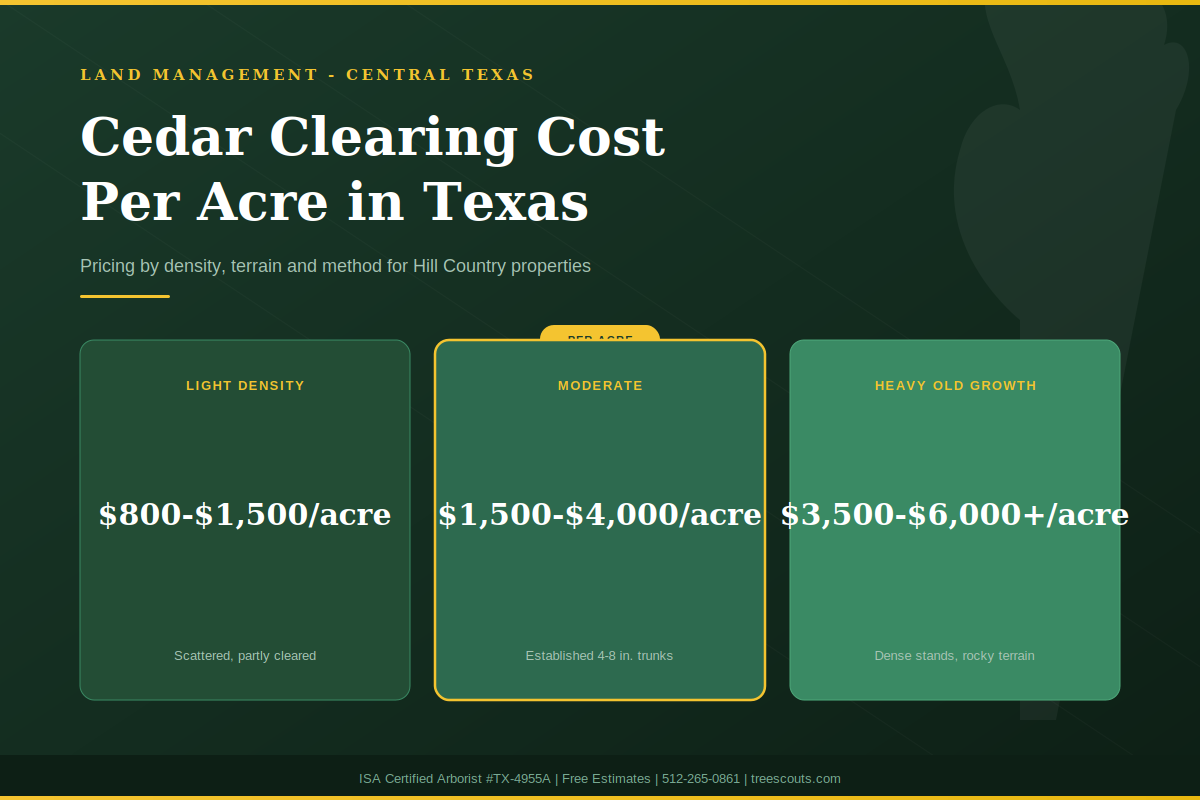
Light cedar density (scattered trees, mostly open ground) — $800 to $1,500 per acre. This is typical on properties that were partially cleared in the past or have naturally sparse cedar growth. Crew can work through it relatively quickly.
Moderate cedar density (thick coverage, 4-8 inch diameter trunks) — $1,500 to $4,000 per acre. This is the most common scenario we see on Georgetown-area properties. The cedar is established, but not old-growth. Requires systematic cutting with stump treatment to prevent regrowth.
Heavy or old-growth cedar (dense stands, trunks 10+ inches) — $3,500 to $6,000+ per acre. Old-growth Ashe Juniper on rocky Hill Country terrain is slow, labor-intensive work. The trunks are thick, the root systems are entrenched in limestone, and equipment access is often limited.
These prices generally include cutting, stacking or chipping debris, and stump treatment. Hauling debris off-site adds cost — on larger properties, we often recommend on-site chipping or burn pile management instead.
What Drives the Price Up
Beyond density, several factors affect what cedar clearing costs on your specific property:
Terrain and slope. Flat ground with good soil is the easiest to work on. Rocky, sloped terrain — common west of Georgetown and throughout Liberty Hill and Dripping Springs — slows everything down. Crews can't use machinery as easily, which means more hand-cutting and more hours.
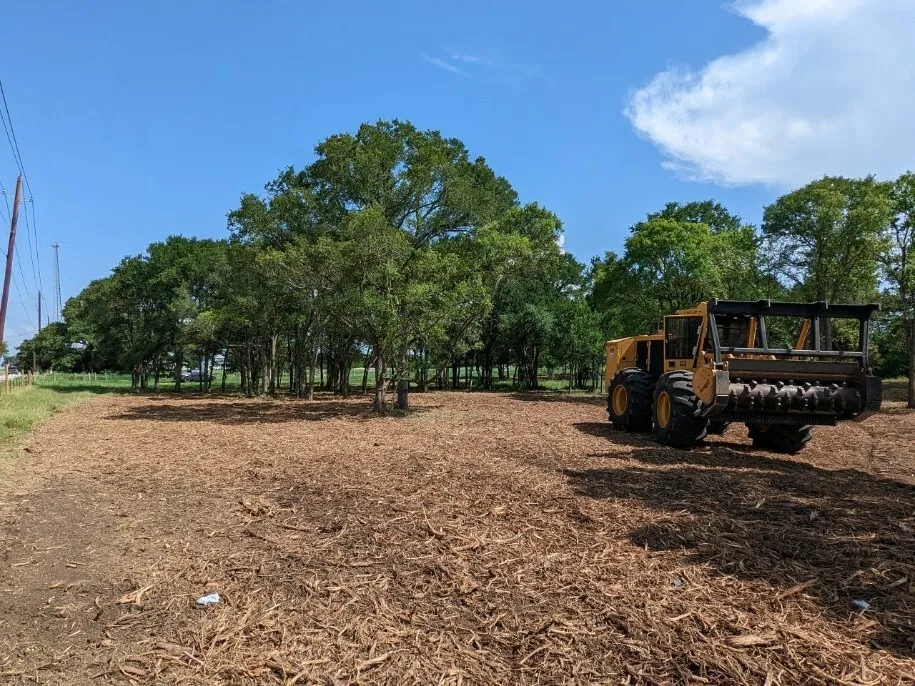
Equipment access. If we can get a skid steer or forestry mulcher onto your property, the work goes dramatically faster (and cheaper) than hand-clearing alone. But many Hill Country properties have narrow gates, no road access to the back acreage, or terrain that won't support heavy equipment.
Selective vs. total clearing. Clearing every cedar on the property is straightforward — the crew doesn't have to decide what stays and what goes. Selective clearing, where you want to preserve certain trees (native hardwoods, specific live oaks, healthy pecans) while removing only the cedar, requires more skill and judgment. It's worth the extra cost because it produces a better result, but it does take longer.
Debris disposal method. You have options: on-site chipping (converted to mulch you can use), burn piles (check Williamson County burn restrictions first), or haul-off to a disposal site. On-site chipping is usually the most economical for properties with space.
Why Cedar Clearing Is Worth the Investment
The cost seems high until you consider what you get in return:
- Water recovery. A single mature Ashe Juniper can consume 30+ gallons of water per day. Clearing dense cedar from a 5-acre property can put thousands of gallons back into the water table and nearby springs.
- Fire mitigation. Cedar is one of the most flammable species in Texas. Dense cedar stands near structures are a serious wildfire risk — especially relevant in the Bee Cave, Lakeway, and Hill Country areas where wildfire-urban interface is a growing concern.
- Property value. Cleared, managed acreage is worth significantly more than dense, overgrown cedar thicket. Views open up, usable space increases, and the property becomes more attractive to buyers.
- Native habitat restoration. Cedar crowds out native grasses, wildflowers, and hardwoods. Removing it allows native vegetation to recover, which supports wildlife diversity and overall land health.
- Allergen reduction. Mountain cedar pollen is the #1 allergen in Central Texas. Fewer cedar trees on your property means fewer allergens in your immediate environment.
Selective Clearing vs. Total Removal — What We Recommend
I almost always recommend selective clearing over total removal. Here's why: some cedar serves a purpose. On steep slopes, cedar roots help prevent erosion. Along property boundaries, cedar can provide wind protection and privacy. And in certain situations, keeping a few mature cedars adds character to the landscape.
Our approach is to walk the property with you, identify which cedar needs to go and which might be worth keeping, and create a clearing plan that maximizes your goals while maintaining land health. We protect every native hardwood, mark oaks and elms for preservation, and create defensible space around structures without stripping the land bare.
When to Schedule Cedar Clearing
The best time for cedar clearing in Central Texas is fall through winter (October through February):
- Ground is firmer and less prone to equipment rutting
- Allergen concerns are lower (you don't want crews shaking cedar pollen while you're already suffering)
- Cooler temperatures mean longer work days and better crew efficiency
- Burn restrictions are generally more relaxed in winter months (check county regulations)
Spring clearing works but wet conditions can cause soil compaction from heavy equipment. Summer clearing is possible but heat limits crew productivity and increases fire risk from equipment sparks.
Cedar Clearing for Different Property Types
Residential lots (0.5 to 2 acres). Most Georgetown homeowners with cedar issues have scattered trees encroaching on their yard or fence line. These are smaller jobs that can usually be completed in a day. Cost: $500 to $2,000 depending on the number and size of trees.
Small acreage (2 to 10 acres). Common in Liberty Hill and rural Georgetown. These properties often need a phased approach — clearing a few acres per season to spread the cost and allow the land to recover between phases.
Ranch and large acreage (10+ acres). For larger properties, we can bring in forestry mulching equipment that processes cedar in place — mulching the tree, brush, and stump in one pass. It's faster and more cost-effective at scale than hand-clearing.
Get a Cedar Clearing Estimate for Your Property
Every property is different, and the only way to get an accurate quote is an on-site visit where we can evaluate density, terrain, access, and your specific goals. Tree Scouts provides free on-site estimates across Georgetown, Liberty Hill, Leander, Dripping Springs, Bee Cave, and Lakeway. Schedule your free estimate or call 512-265-0861.
Tree & Cedar Removal · Commercial Land Clearing · Arborist Consultations
Free estimate
Not sure what your trees need?
Book a free estimate with an ISA Certified Arborist. We walk your property, tell you what actually needs doing, and put the plan in writing. No pressure and no upsell.
500+ five-star Google reviews · ISA Certified Arborists · Insured crews · Scouts Honor promise
About the Author
Levi Williams, ISA Certified Arborist #TX-4955A | TRAQ Qualified | Wildfire Risk Reduction Qualified (WRRQ) | TDA Pesticide License #0933008 | Urban Forestry #TX-4955AF
Levi is the lead arborist at Tree Scouts Tree Service, headquartered in Georgetown, TX. His expertise has been cited by Martha Stewart for fruit tree pruning guidance. He oversees all arborist assessments, treatment plans, and crew operations across 12 Central Texas service areas. Levi follows ISA and ANSI A300 standards on every project.

Request your free quote
Tell us about your trees and a real Tree Scout will get back to you quickly. We only use your information to prepare your quote.
What happens next
1
We reach out fast to confirm details, by call or text, whichever you prefer.
2
A Tree Scout confirms your free flat-rate quote on site.
3
We do the work, clean up, and walk the finished job with you. Pay the balance only when you are happy.
What We Do
Complete Tree Care for Central Texas Homes and HOAs
Every service is quoted free on site, overseen by an ISA Certified Arborist, and finished with a walkthrough before the balance is collected.

Tree Trimming
ANSI A300 pruning for live oaks and shade trees. No topping, no over-thinning.
Learn more
Tree Removal
Safe takedowns near homes, fences, and lines, with complete haul-off and cleanup.
Learn more
Stump Grinding
Flat-rate grinding 6 to 8 inches below grade, ready for sod or replanting.
Learn more
Oak Wilt Treatment
Propiconazole trunk injections and prevention plans for Central Texas oaks.
Learn more
Tree Fertilization
Deep root feeding matched to Central Texas soil and your tree species.
Learn more
Tree Planting
Right tree, right place. We source, deliver, and plant for long-term health.
Learn more
Arborist Services
Diagnosis, risk evaluation, and written reports from certified arborists.
Learn more
Emergency Tree Service
Storm damage and hazardous trees handled fast, any day of the week.
Learn moreCommon Questions
How much does cedar clearing cost per acre in Texas?
Cedar clearing in Central Texas typically costs $1,500 to $4,000 per acre for moderate density. Light cedar runs $800 to $1,500 per acre. Heavy, old-growth cedar on rocky terrain can exceed $5,000 per acre. Pricing depends on density, terrain, and disposal method.
Should I clear all the cedar on my property?
Not necessarily. Selective clearing is often better than total removal. Some cedar provides erosion control on slopes, wildlife habitat, and wind protection. Our arborist can help you develop a clearing plan that balances your goals with land health.
What is the best time of year for cedar clearing in Texas?
Fall through winter (October through February) is ideal. The ground is firmer, allergen concerns are lower, and crews can work longer days in cooler weather. Spring clearing works but wet conditions can cause soil compaction from equipment.
Related Tips
Service Areas
Tree Care Across Central Texas
Tree Scouts provides ISA standard tree trimming, tree removal, and arborist care across Georgetown, Leander, Lakeway, Austin, Cedar Park, Round Rock, Pflugerville, Hutto, and the surrounding Hill Country. Every estimate is free and walked by an ISA Certified Arborist.
Georgetown
Tree care in Georgetown, TX
Leander
Tree care in Leander, TX
Austin
Tree care in Austin, TX
Cedar Park
Tree care in Cedar Park, TX
Round Rock
Tree care in Round Rock, TX
Lakeway
Tree care in Lakeway, TX
Pflugerville
Tree care in Pflugerville, TX
Hutto
Tree care in Hutto, TX
Liberty Hill
Tree care in Liberty Hill, TX
Bee Cave
Tree care in Bee Cave, TX
Dripping Springs
Tree care in Dripping Springs, TX
Marble Falls
Tree care in Marble Falls, TX