Tree Care Tips
What Is Deep Root Fertilization and Do Your Austin Trees Need It?
What Is Deep Root Fertilization?
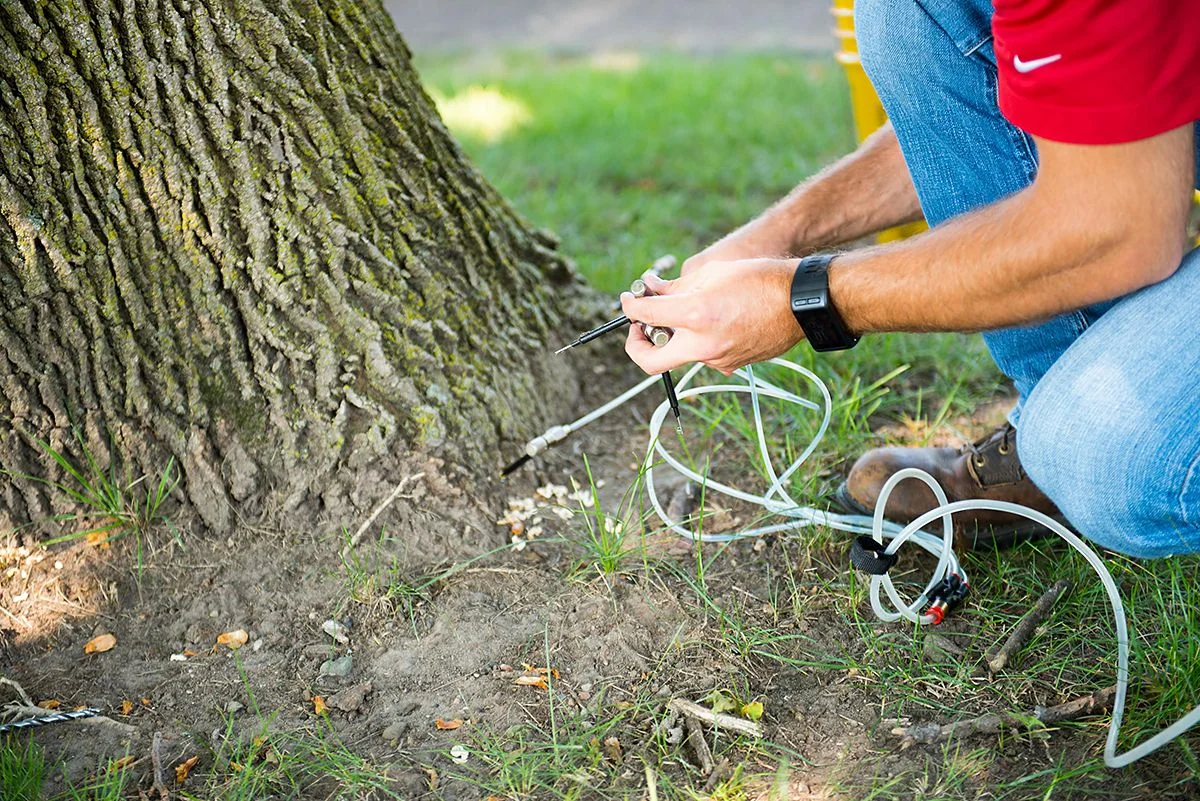
Deep root fertilization is exactly what it sounds like: injecting fertilizer directly into the soil around a tree's root zone, at a depth of 6 to 12 inches below the surface. Unlike spreading granular fertilizer on the lawn and hoping some reaches your tree's roots, deep root injection bypasses the turfgrass root layer entirely and delivers nutrients where the tree's feeder roots actually absorb them.
The process uses a specialized probe connected to a pressurized tank. An ISA certified arborist inserts the probe at multiple points around the tree's drip line (the outer edge of the canopy), spacing injections 2-3 feet apart in a grid pattern. Each injection delivers a measured dose of slow-release liquid fertilizer formulated for Central Texas soil conditions.
The entire process takes 15 to 30 minutes per tree depending on trunk diameter. There's no excavation, no mess, and no disruption to your lawn beyond small probe holes that close within days.
Why Austin Trees Need Deep Root Fertilization
Here's the problem most Austin homeowners don't realize: your trees are competing with your lawn for nutrients, and losing.
Turfgrass roots occupy the top 2-4 inches of soil. Tree feeder roots live deeper, but the two root zones overlap significantly. When you fertilize your lawn, the grass absorbs the majority of those nutrients before they ever reach the tree's root zone. Meanwhile, your trees are trying to sustain thousands of pounds of canopy and root mass on whatever's left over.
Add Austin-specific challenges and the nutrient gap gets worse:
Alkaline soil. Most of Austin sits on limestone-derived soils with a pH of 7.5 to 8.5. At that pH, iron, manganese, and zinc become chemically unavailable to trees even though they're present in the soil. This is why you see interveinal chlorosis (yellowing leaves with green veins) on so many Austin live oaks — it's not a disease, it's a nutrient availability problem.
Compacted urban soils. Construction activity, foot traffic, and years of mowing compact Austin's clay soils, reducing the oxygen and water infiltration that tree roots need. Deep root injection physically fractures compacted soil around each injection point, improving aeration as a bonus.
Drought stress cycles. Austin's climate swings between drought and flood. Trees stressed by summer drought need strong nutrient reserves to recover. Without supplemental feeding, each drought cycle weakens the tree further. Abiotic stress accumulates over time and leads to decline that's hard to reverse.
How Much Does Deep Root Fertilization Cost in Austin?
For most residential trees in Austin, deep root fertilization runs $150 to $400 per tree depending on trunk diameter and the fertilizer blend used. Here's how it typically breaks down:
- Small trees (under 10 inch trunk diameter): $100 to $200
- Medium trees (10 to 20 inches): $200 to $300
- Large trees (20 inches and up): $300 to $400+
Most homeowners treat 3 to 5 trees at once for a package rate of $400 to $800 total. That's significantly cheaper than treating a declining tree that's gone too long without proper nutrition — removing a dead tree costs $1,000 to $3,000+.
Annual treatments are recommended for best results, though even a single treatment produces visible improvement in canopy color and density within one growing season.
When Is the Best Time for Deep Root Fertilization?
Two windows work best in Central Texas:
Fall (October through November) is the ideal time. Trees are winding down above-ground growth but their root systems remain active well into December in our mild winters. Nutrients delivered in fall feed root growth through winter, building reserves for the spring flush. Plus, there's less competition from turfgrass during dormant lawn season.
Early spring (late February through March) is the second-best window. Fertilization at this time supports the spring growth flush when nutrient demand peaks. This works especially well for trees showing signs of decline — the nutrients are available right when the tree needs them most.
When NOT to fertilize: Avoid deep root feeding during peak summer heat (June through August) when trees are already water-stressed. Adding nutrients during drought stress can actually push growth the tree can't sustain, doing more harm than good. Also avoid fertilizing trees that are actively infected with oak wilt — fertilization can accelerate the disease rather than help the tree fight it.
Which Trees Benefit Most from Deep Root Fertilization?
Not every tree on your property needs it. Here's where deep root fertilization delivers the highest return:
High-value live oaks. These are the trees you can't replace in your lifetime. A 30-inch live oak took 80+ years to grow. Keeping it healthy with annual fertilization is a fraction of the cost of dealing with decline or removal.
Trees showing stress symptoms. Pale or yellowing leaves, sparse canopy, premature leaf drop, small leaves, and reduced growth are all signs of nutrient deficiency or root stress. Deep root fertilization addresses the underlying cause rather than just treating symptoms.
Trees in compacted urban settings. Oaks surrounded by driveways, patios, or heavy foot traffic areas have compromised root zones. The physical soil fracturing from deep root injection can be as beneficial as the nutrients themselves.
Post-construction recovery. If your trees survived a construction project but look stressed from root zone disturbance, deep root fertilization accelerates recovery by delivering nutrients directly to whatever root system remains functional.
Trees that probably DON'T need it: Healthy trees in naturalized settings with no turf competition, young trees under 5 years old (focus on watering instead), and any tree you're planning to remove anyway.
What's Actually in the Fertilizer?
The specific blend matters. We use a slow-release formulation designed for Central Texas alkaline soils that includes:
- Nitrogen (N) for canopy growth and leaf production — delivered as slow-release to avoid burn
- Phosphorus (P) for root development
- Potassium (K) for drought tolerance and disease resistance
- Iron and manganese in chelated forms that remain available in high-pH soils (this is critical for Austin)
- Mycorrhizal fungi — beneficial organisms that colonize root tips and dramatically increase nutrient absorption capacity
- Humic acids to improve soil structure and water retention
This isn't the same NPK formula you'd spread on your lawn. Tree-specific fertilization addresses the nutrient lockout problems that Austin's alkaline soils create, and the slow-release delivery means the tree feeds gradually over months rather than getting a short spike that dissipates quickly.
Deep Root Fertilization vs. Surface Fertilizer vs. Fertilizer Spikes
Deep root injection delivers nutrients directly to the feeder root zone, bypasses turf competition, and fractures compacted soil. This is the professional standard recommended by the ISA.
Surface granular fertilizer (the bag you spread on your lawn) primarily feeds turfgrass. Some nutrients eventually leach down to tree roots, but the delivery is inconsistent and most is consumed by the grass first.
Fertilizer spikes (the stakes you hammer into the ground) concentrate nutrients in a small area around each spike rather than distributing evenly through the root zone. They're better than nothing but far less effective than professional injection.
For high-value trees in urban and suburban settings, deep root injection is the only method that reliably delivers nutrients where they need to go.
Schedule Your Austin Tree Fertilization
Tree Scouts' ISA certified arborists assess every tree before recommending treatment. We'll tell you honestly which trees will benefit from fertilization and which ones don't need it. Our Scout's Honor approach means we don't upsell services your trees don't need.
We serve homeowners across Austin, Lakeway, Cedar Park, Georgetown, Leander, Round Rock, and Steiner Ranch. Schedule your free tree health assessment or call 512-265-0861.
Tree Fertilization Services · Arborist Consultations · Oak Wilt Treatment
Free estimate
Not sure what your trees need?
Book a free estimate with an ISA Certified Arborist. We walk your property, tell you what actually needs doing, and put the plan in writing. No pressure and no upsell.
500+ five-star Google reviews · ISA Certified Arborists · Insured crews · Scouts Honor promise
About the Author
Levi Williams, ISA Certified Arborist #TX-4955A | TRAQ Qualified | Wildfire Risk Reduction Qualified (WRRQ) | TDA Pesticide License #0933008 | Urban Forestry #TX-4955AF
Levi is the lead arborist at Tree Scouts Tree Service, headquartered in Georgetown, TX. His expertise has been cited by Martha Stewart for fruit tree pruning guidance. He oversees all arborist assessments, treatment plans, and crew operations across 12 Central Texas service areas. Levi follows ISA and ANSI A300 standards on every project.

Request your free quote
Tell us about your trees and a real Tree Scout will get back to you quickly. We only use your information to prepare your quote.
What happens next
1
We reach out fast to confirm details, by call or text, whichever you prefer.
2
A Tree Scout confirms your free flat-rate quote on site.
3
We do the work, clean up, and walk the finished job with you. Pay the balance only when you are happy.
What We Do
Complete Tree Care for Central Texas Homes and HOAs
Every service is quoted free on site, overseen by an ISA Certified Arborist, and finished with a walkthrough before the balance is collected.

Tree Trimming
ANSI A300 pruning for live oaks and shade trees. No topping, no over-thinning.
Learn more
Tree Removal
Safe takedowns near homes, fences, and lines, with complete haul-off and cleanup.
Learn more
Stump Grinding
Flat-rate grinding 6 to 8 inches below grade, ready for sod or replanting.
Learn more
Oak Wilt Treatment
Propiconazole trunk injections and prevention plans for Central Texas oaks.
Learn more
Tree Fertilization
Deep root feeding matched to Central Texas soil and your tree species.
Learn more
Tree Planting
Right tree, right place. We source, deliver, and plant for long-term health.
Learn more
Arborist Services
Diagnosis, risk evaluation, and written reports from certified arborists.
Learn more
Emergency Tree Service
Storm damage and hazardous trees handled fast, any day of the week.
Learn moreCommon Questions
What is deep root fertilization?
Deep root fertilization injects a slow-release liquid fertilizer directly into the soil around a tree's root zone at a depth of 6-12 inches. This delivers nutrients below the grass root level where tree feeder roots actually absorb them, bypassing the competition from turfgrass.
How much does deep root fertilization cost in Austin?
Deep root fertilization in Austin typically costs $150 to $400 per tree depending on trunk diameter and the fertilizer blend used. Most homeowners treat 3-5 trees at once for a package rate of $400 to $800. Annual treatments are recommended for best results.
When is the best time for deep root fertilization in Austin?
Fall (October-November) and early spring (February-March) are the ideal windows. Fall treatments feed roots during winter when competition from grass is lowest. Spring treatments support the flush of new growth. Avoid fertilizing during peak summer heat or severe drought.
Related Tips


Service Areas
Tree Care Across Central Texas
Tree Scouts provides ISA standard tree trimming, tree removal, and arborist care across Georgetown, Leander, Lakeway, Austin, Cedar Park, Round Rock, Pflugerville, Hutto, and the surrounding Hill Country. Every estimate is free and walked by an ISA Certified Arborist.
Georgetown
Tree care in Georgetown, TX
Leander
Tree care in Leander, TX
Austin
Tree care in Austin, TX
Cedar Park
Tree care in Cedar Park, TX
Round Rock
Tree care in Round Rock, TX
Lakeway
Tree care in Lakeway, TX
Pflugerville
Tree care in Pflugerville, TX
Hutto
Tree care in Hutto, TX
Liberty Hill
Tree care in Liberty Hill, TX
Bee Cave
Tree care in Bee Cave, TX
Dripping Springs
Tree care in Dripping Springs, TX
Marble Falls
Tree care in Marble Falls, TX