Tree Care Tips
Levi Williams Earns Wildfire Risk Reduction Qualification (WRRQ) — What It Means for Central Texas Homeowners
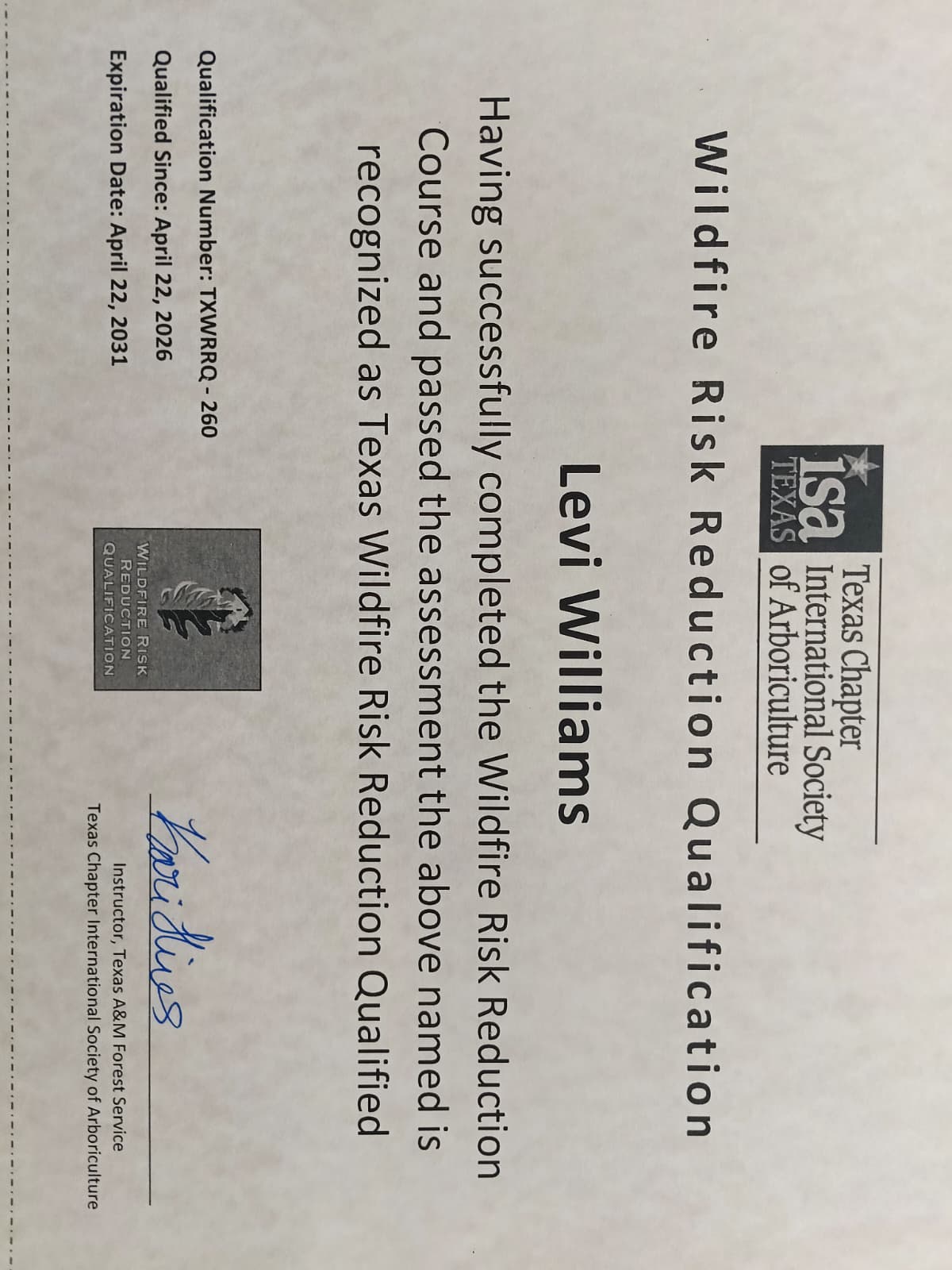
Tree Scouts is proud to share that our lead arborist Levi Williams has officially earned the Wildfire Risk Reduction Qualification (WRRQ) from the Texas Chapter of the International Society of Arboriculture, a credential developed in partnership with Texas A&M Forest Service. Levi passed the qualification on April 22, 2026, adding another specialized credential to a roster that already includes ISA Certified Arborist (TX-4955A), TRAQ Qualified, and Urban Forest Professional. For Central Texas homeowners, this means our team now brings formal, field-tested expertise to one of the most underappreciated risks in the region: wildfire.
What the WRRQ Actually Is
The Wildfire Risk Reduction Qualification is not a marketing badge. It is a two-day course and assessment built by Texas A&M Forest Service and administered by ISA Texas, designed specifically for ISA Certified Arborists who want to add wildfire mitigation to their professional toolbox. Candidates learn how fire moves through a landscape, how embers behave in the wind, how to identify the vegetation conditions that escalate a small ignition into a structure loss, and how to prescribe pruning and removal that interrupts those conditions. The credential requires passing both a written exam and a field test on actual homes near the training site.
The point of the qualification is straightforward: arborists are already on residential properties every week, and they are uniquely positioned to spot wildfire risks the homeowner cannot see. A WRRQ-qualified arborist looks at a tree the way a fire behavior analyst looks at fuel — not just for health and structure, but for how it would behave in a wildfire scenario. ISA Texas maintains a public list of qualified arborists, and Levi will be added to it as part of the next update.
Why Wildfire Risk Is a Real Issue in Central Texas
It is easy to think of wildfire as a Panhandle, West Texas, or California problem. It is not. More than 32% of the state's population lives in the wildland-urban interface, and Central Texas is one of the fastest-growing parts of that interface. Georgetown, Leander, Cedar Park, Liberty Hill, Lakeway, Bee Cave, and the western edges of Austin sit on Hill Country terrain that combines dense cedar and oak canopy, prolonged drought cycles, and homes built deep into the trees. The 2011 Bastrop Complex Fire, just 30 miles east of Austin, destroyed more than 1,600 homes — a reminder that the conditions for a major event already exist here.
Two factors make Central Texas especially vulnerable. First, the WUI keeps expanding: every new subdivision pushed into the cedar breaks adds homes that depend on defensible space for survival. Second, our climate is built for fire. Long, hot summers, recurring drought, and seasonal high winds dry vegetation to ignition-ready moisture levels for months at a time. The question for homeowners is not whether the conditions will line up — they already do — but whether the property is prepared for the day they do.

What Defensible Space Means on Your Property
Defensible space is the buffer between a home and the surrounding vegetation. Texas A&M Forest Service and the National Fire Protection Association organize that buffer into three home ignition zones, and a WRRQ assessment walks every one of them.
- The immediate zone (0 to 5 feet from the home) is the most critical. This is where wind-blown embers land, sit, and ignite the structure itself. Mulch beds, dry leaves in gutters, dead branches against siding, and combustible decking are the issues here.
- The intermediate zone (5 to 30 feet) is about breaking up fuel continuity. Tree canopies should not touch each other or the house. Ladder fuels — the low branches and shrubs that let a ground fire climb into the canopy — need to be removed. Trees should be limbed up so the lowest branches sit at least 6 feet off the ground.
- The extended zone (30 to 100 feet) is about slowing fire down. Trees can stay, but they need spacing between canopies. Dead wood, leaf litter, and brush piles need to be cleared. Heavy undergrowth that would carry a fast surface fire should be thinned.
Most Central Texas properties we see have problems in all three zones. The most common one is ladder fuels: a healthy live oak with cedar saplings and yaupon growing right up under it, turning what could be a low-intensity ground fire into a canopy fire that throws embers half a mile downwind.
What Levi's WRRQ Adds to Tree Scouts
Tree Scouts has always approached tree trimming, tree removal, and arborist consultations through the lens of long-term tree health. The WRRQ adds a second lens: how the same trees would behave in a wildfire, and what changes can reduce that risk without compromising the property's shade, beauty, or ecological value. In practice, this means a homeowner concerned about wildfire can now book an on-site assessment with a qualified arborist who can walk the home ignition zones, identify the specific risk factors, and prescribe a mitigation plan in writing.
This is also a credential that pairs naturally with our existing work. A property that needs oak wilt treatment often has the same canopy density issues that drive wildfire risk. A property that needs land clearing for cedar removal is often a property whose owner is already worried about fire behavior. The WRRQ lets us bring those conversations together instead of treating them separately.
What Homeowners Can Do Right Now
You do not need to wait for a wildfire watch to start working on defensible space. The highest-impact things a Central Texas homeowner can do this season are straightforward:
- Walk the immediate zone (0 to 5 feet from the house) and remove anything combustible — dry mulch, dead branches against siding, leaves in gutters, firewood stacked against the wall.
- Limb up trees in the intermediate zone so the lowest live branches are at least 6 feet off the ground. This breaks the ladder fuel pathway from grass to canopy.
- Look for tree canopies touching each other or touching the roof. Canopies that touch let fire jump.
- Remove dead trees and dead limbs anywhere within 100 feet of structures. Dead wood is the fastest-igniting fuel on the property.
- If you live in the WUI — anywhere west of MoPac, Hill Country acreage, or any neighborhood backing onto greenbelt or preserve land — book a professional assessment.
Why Tree Scouts
Tree Scouts is headquartered in Georgetown and serves Central Texas with an ISA Certified, TRAQ Qualified, WRRQ Qualified team. We have been featured on FOX 7 Austin for spring tree care guidance, cited by Martha Stewart and The Spruce as expert sources on tree care, and we hold BBB Accreditation alongside more than 400 five-star Google reviews across our Georgetown, Austin, and Leander locations. Adding the WRRQ to our roster means our clients now get a level of wildfire-mitigation expertise that very few Central Texas tree services can match.
Whether you need tree trimming, safe tree removal, oak wilt treatment, a wildfire risk assessment, or just an honest opinion on what your property needs going into fire season, our team is here.
We serve Georgetown, Austin, Leander, Cedar Park, Round Rock, Lakeway, Liberty Hill, Hutto, Bee Cave, and the surrounding Hill Country communities. Call 512-265-0861 or book a free tree health and wildfire risk assessment today.
Free estimate
Not sure what your trees need?
Book a free estimate with an ISA Certified Arborist. We walk your property, tell you what actually needs doing, and put the plan in writing. No pressure and no upsell.
500+ five-star Google reviews · ISA Certified Arborists · Insured crews · Scouts Honor promise
Levi Williams, ISA Certified Arborist #TX-4955A | TRAQ Qualified | Wildfire Risk Reduction Qualified (WRRQ #TXWRRQ-260) | TDA Pesticide License #0933008 | Urban Forestry #TX-4955AF
Levi is the lead arborist at Tree Scouts Tree Service, headquartered in Georgetown, TX. His expertise has been cited by Martha Stewart and The Spruce across national publications on stump grinding, driveway tree selection, and fruit tree pruning. He oversees all arborist assessments, treatment plans, and crew operations across 12 Central Texas service areas. Levi follows ISA, ANSI A300, and Texas A&M Forest Service standards on every project.

Request your free quote
Tell us about your trees and a real Tree Scout will get back to you quickly. We only use your information to prepare your quote.
What happens next
1
We reach out fast to confirm details, by call or text, whichever you prefer.
2
A Tree Scout confirms your free flat-rate quote on site.
3
We do the work, clean up, and walk the finished job with you. Pay the balance only when you are happy.
What We Do
Complete Tree Care for Central Texas Homes and HOAs
Every service is quoted free on site, overseen by an ISA Certified Arborist, and finished with a walkthrough before the balance is collected.

Tree Trimming
ANSI A300 pruning for live oaks and shade trees. No topping, no over-thinning.
Learn more
Tree Removal
Safe takedowns near homes, fences, and lines, with complete haul-off and cleanup.
Learn more
Stump Grinding
Flat-rate grinding 6 to 8 inches below grade, ready for sod or replanting.
Learn more
Oak Wilt Treatment
Propiconazole trunk injections and prevention plans for Central Texas oaks.
Learn more
Tree Fertilization
Deep root feeding matched to Central Texas soil and your tree species.
Learn more
Tree Planting
Right tree, right place. We source, deliver, and plant for long-term health.
Learn more
Arborist Services
Diagnosis, risk evaluation, and written reports from certified arborists.
Learn more
Emergency Tree Service
Storm damage and hazardous trees handled fast, any day of the week.
Learn moreCommon Questions
What is the Wildfire Risk Reduction Qualification (WRRQ)?
The Wildfire Risk Reduction Qualification (WRRQ) is a specialized credential developed by Texas A&M Forest Service and the Texas Chapter of the International Society of Arboriculture. It is awarded to ISA Certified Arborists who complete a two-day training course and pass both a written exam and a field assessment. The qualification recognizes arborists with specialized expertise in evaluating wildfire risk to homes and properties and recommending mitigation strategies that reduce that risk.
Why does the WRRQ matter for Central Texas homeowners?
Central Texas sits squarely in the wildland-urban interface — the zone where neighborhoods push into natural areas. More than 8 million Texans live in this interface, and recurring drought, heat, and dense cedar and oak canopy make the Hill Country and surrounding suburbs especially vulnerable. A WRRQ-qualified arborist can assess the home ignition zones around your property, identify ladder fuels and ember-trap vegetation, and prescribe pruning and removal that materially reduces the risk of structure loss in a wildfire.
What does a wildfire risk assessment from a WRRQ arborist actually involve?
A WRRQ assessment walks the three home ignition zones — the immediate zone (0 to 5 feet from the home), the intermediate zone (5 to 30 feet), and the extended zone (30 to 100 feet). The arborist evaluates tree species, canopy spacing, ladder fuels, dead wood, debris accumulation, and the relationship between vegetation and structures. The deliverable is a prioritized mitigation plan that identifies which trees should be limbed up, which should be removed, where canopy gaps should be created, and what landscape changes will reduce ember ignition risk.
Related Tips

Service Areas
Tree Care Across Central Texas
Tree Scouts provides ISA standard tree trimming, tree removal, and arborist care across Georgetown, Leander, Lakeway, Austin, Cedar Park, Round Rock, Pflugerville, Hutto, and the surrounding Hill Country. Every estimate is free and walked by an ISA Certified Arborist.
Georgetown
Tree care in Georgetown, TX
Leander
Tree care in Leander, TX
Austin
Tree care in Austin, TX
Cedar Park
Tree care in Cedar Park, TX
Round Rock
Tree care in Round Rock, TX
Lakeway
Tree care in Lakeway, TX
Pflugerville
Tree care in Pflugerville, TX
Hutto
Tree care in Hutto, TX
Liberty Hill
Tree care in Liberty Hill, TX
Bee Cave
Tree care in Bee Cave, TX
Dripping Springs
Tree care in Dripping Springs, TX
Marble Falls
Tree care in Marble Falls, TX